
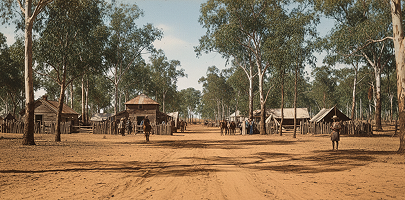
Transportation; White Slavery?
Transportation is the term given to the relocation of convicted criminals from Britain to overseas locations within the British Empire. Australia became the focus for ships converted to accommodate prisoners as the British parliament resolved to rid itself of the criminal element of 18th and 19th century British society. The American Revolution saw the transportation moved to Australia as Captain James Cook had discovered the east coast of the Australian land mass in 1770 and it was the then most remote point of British control at the time.
The first shipment of convicts arrived to settle the east coast of Australia at Botany Bay in 1788. The settlement was named New South Wales and claimed the eastern two thirds of the continent. At the time, no other nation was in a position or interested in disputing the claim. Almost by disinterest, Australia soon became a British asset to later be envied by the rest of the world. For some 52 years, convicts were the dominant workforce for the colony and when transportation to NSW ceased in 1840, the penal institutions in Tasmania and Norfolk Island continued with the last convict ship arriving in Hobart in 1853.
However, transportation of convicts was a desperate decision of the Swan River Colony in Western Australia to save it as it had been established in 1829 as a ‘free’ colony with no convict labour. In establishing the Swan River Colony (Perth) the western third of Australia was claimed to prevent any other nation having a foothold on the island continent.
By the structure of a ‘little England’ without convicts, the settlers hoped for a paradise free of the ills of criminals. What upset this ideal was the rise of the indentured labourers who turned away from employment to work their own land holdings. The settlers with land grants who had used their capital for farm supplies and stock could not prosper and the economy was failing up to the point when a petition to the British Government for ‘labour’ was answered by the revival for Transportation. The Convicts were petitioned to be minor criminals of 7-10year sentences so they would not be ‘hardened’ criminals and were expected to become good citizens on their release.
The unexpected outcome was the surreptitious abandonment of ‘white slavery’ as that was a term considered by some, for the desperate need for labour overcame the resistance to close control. The first convicts arrived in late 1850 and were put to work immediately on public works. (their prison, bridges and roads). Soon the best behaved convicts were granted ticket-of-Leave which allowed them to work outside the establishment and work for the settlers.
What enabled such a situation was the urgency for labour, the mildness of the criminals, their hopes for early release and freedom, the prospect of no escape as there was only wilderness to escape into and the scarcity of food and shelter. One aspect that surprised the convicts was the climate and the environment. The benign weather meant summers were hot but had cooling afternoon breezes and winter, which was mild with no freezing temperature and thus no ice and snow, but plenty of warm sunshine for the shorter days of the winter months.
The land was also easy to work as a sandy soil and low hills formed a landscape of eucalypt forests and low scrub that was easily cleared. Timber was a readily available source with Jarrah and Karri trees found to be excellent hardwood for construction and burnt for heat. One of the ideas of the original settlers was to act as a source of mounts for India (again the East India Company appears) at a small settlement south of Perth named Australind – a combined name of the two nations. This was not a successful enterprise but the place is now an outer residential area of the port city of Bunbury.
By 1868 the colony was well established and transportation to Australia was closed forever. The experience was considered success by the colonial government as labour was now available from free settlers and the economy was well secured with mineral wealth and primary produce sustaining healthy growth.
On an end note, just prior to the first convicts’ arrival in 1850, a portent of what became a great future success for the state was the discovery of galena some 300 miles north of Perth in the Murchison River. Yes, IN the river. It was a seam of almost pure lead standing up from the bed of the river, easily seen during dry season. The exploitation was a second financial blessing for the colony and established the Northampton Mineral Fields as a source of valuable minerals. It was the beginning of the mining industry of the state and was followed by the gold discoveries of the 1890’ and today the Pilbara region is the largest exporter of iron ore in the world.
The New Nation of AUSTRALIA
At the end of the 19th century the established states of New South Wales, Queensland, Victoria, Tasmania and South Australia agitated for a union of all states to form a single entity of one nation. Conferences to this end included Western Australia but it was the only state which remained a separation. There was considerable concern by the state that the growing wealth from the recent gold discoveries would be consumed by the other states. Each state was by now a partially independent state from Britain but retained a level of devolved powers subjected to British control. The leaders of each state were titled Premier and operated like an independent state with a Governor as the Queens representative and an executive council.
The vexed problem remained unresolved so the states sent a delegation with a petition and draft constitution to Britain for approval and Queen Victoria’s assent to create the new nation, Australia. A small cohort of West Australians accompanied the delegation to report back to the Western Australian Premier, Sir John Forrest, with the object of influencing the reticent state to join the federation.
One of the arguments for joining was the issue of security. If Western Australia joined the federation, there would be only one nation on the continental land mass so no separate customs or defence systems would be needed. One of the desires for WA to join the federation was for the construction of a railway linking the eastern states to Western Australia. It would be a massive undertaking as the barren land of the Nullarbor Plain was a thousand miles of waterless undulating land.
The state’s appeal to the British Parliament for federation was successful and once the delegation returned to Australia with dates for the establishment of the inaugural parliament, the Governor of Western Australia forced the issue by calling a referendum on the question which overturned the expected refusal. What happened was the goldfields population were made up of many eastern states gold prospectors who wanted to join the federation and have security that their governance would not be in their interests.
This was a very powerful lobby as in 1851, the gold prospectors of the state of Victoria had revolted in the mining town of Ballarat at the overbearing control of the government to impose taxes without representation. It was 1776 America all over again! The uprising was called the Eureka Stockade and lasted only briefly before it was put down.
However, the message was a cause cèlèbre which festered and brought the realisation that independence was approaching and it would be better to accept force of public opinion than risk a larger and more divisive uprising. Many gold prospectors from Ballarat had moved to Western Australia to seek their fortune in the new goldfields and they became a strong voice in the move to create a new nation.
And so Western Australia was eventually a member state of the federation, reluctant initially, but when the question was put to the people, the result was unequivocal YES!
Australia held its first parliament as a new nation in Melbourne on 1st January 1901, presided over by the future King George V.