
Courage and Danger
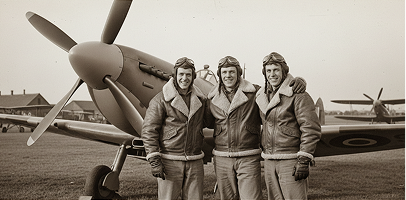
There is no question that the men who flew in the fighters, bombers, flying boats and surveillance patrols (females were excluded from Western Allied air forces but German and especially Russian females were common), were courageous. Danger, as in loss of life and injury were a constant presence in their minds. The legacy of those who survived and recorded their experiences largely (in World War Two) covered over their experiences with attitudes of bravery and respect for those who perished, or worse, suffered with life-long scars.
It was not just the ‘glamorous fighter pilots, bombers required a comprehensive skilled aircrew, engineers, navigators, radio operators, bomb aimers, machine gunners and, often overlooked, their own ground crew whose skill kept their aircraft in the best condition despite the damage from aerial warfare.
When discussing the war in the skies over Europe, modern readers often overlook the role of the system behind the actual combat. Technology and administration to conduct war in the air became increasingly sophisticated. The development of electronic devices and systems required trained operators which the pilot in the sky depended on, this vital information was fed to them through operational briefings and active radio communications in the air. It was a highly technical war and required highly technical minds, not raw strength, to operate them.
Females, came to be a largely unrecognised source of courage and energy. Few females received high honours but their contribution was just as important as the individual pilots in the sky. We must never overlook how the Second World War depended so much on the mobilisation of females in achieving victory over Nazi Germany.
There was a stark contrast between fighter pilots and their bomber compatriots. The fighter pilots initially were guided by radio and strategy of ground-based instructions. For the Luftwaffe, strategy was to defend their bombers as they targeted cities and industrial facilities. Their task was to fend off British fighters from shooting down their bombers. However, the British, although of smaller numbers, used a strategy of their slower Hurricane fighters to aim for the bombers while the faster Spitfires fought the Me109 German fighters.
It became a contest of individual pilots resulting in huge losses of life or serious injury amongst amazing heroism on both sides. Fighter pilots became heroes or martyrs, knights of the skies, with the conflict mostly over England but later, as England gained the upper hand, over occupied Europe.
For the bomber aircrew, they were a team developing into an esprit de corps that sustained their confidence and determination to fight the Luftwaffe fighters to then destroy their warmaking capability. Their courage at staying at their station while under fire from a fighter was courageous to the extreme. They had no protection from bullets or the lethal shrapnel from flak. It was instant injury or death, depriving the bomber of their function and making the bomber vulnerable to further attack.
The day-to-day operations were also very different as the war went on. Initially, the fighters of Britain were acting as the only defence of Britain and stood ready at any time to take off and fly to attack an approaching bomber force. Then, after the Battle of Britain was won by the British, their role became an attacking force to protect their own bombers and become a new form of war, dive bombing or ground attack strafing.
The bombers were very different in their operations. As the war settled into an air war the bomber force expanded to become a strategic weapon sometimes referred to as ‘extended artillery’. Operations were carefully prepared with detailed information of what the target was and how best to destroy it. Technical sophistication as the war progressed enabled the Allies to focus on industries critical to the Nazi war machine and also to destroy major cities by 1000 bomber raids. Hamburg and Dresden were just two examples of these massive bombing raids.
From the very start of the war, no-one had realised how aerial combat would become so ferocious as the First World War was only the beginning of sophisticated aerial combat. The Second World War saw the introduction of much faster aircraft with multiple guns of highly manoeuvrable fighters opposed to four engined bombers with huge bomb loads and multiple defensive machine guns. At the end of the war, very high altitudes and pressurised fuselages allowed bomber development to deliver the greatest bomb in history – the nuclear age came into being at Hiroshima and Nagasaki.